

When Facial Pain Becomes Impossible to Ignore
A sip of water. A breeze against your cheek. Brushing your teeth. Even talking.
For someone with trigeminal neuralgia, ordinary sensations can sometimes trigger sudden, severe facial pain that feels like an electric shock.
The attacks may last seconds to minutes and can occur repeatedly. Some people experience periods of remission, while others develop more persistent aching or burning pain. Severe cases can interfere with eating, sleep, work, and social life. (nhs.uk)
When conventional treatment does not provide enough relief—or causes difficult side effects—patients may begin considering additional options.
Medical cannabis is one of them.
But can cannabis actually help trigeminal neuralgia, and where does it fit alongside established nerve-pain treatment?
What Is Trigeminal Neuralgia?
Trigeminal neuralgia (TN), sometimes called tic douloureux, is a chronic pain disorder involving the trigeminal nerve—the major nerve responsible for sensation in the face.
- Typical attacks are:
- Sudden and extremely painful
- Often described as electric shocks, stabbing, or shooting pain
- Usually felt on one side of the face
- Triggered by activities such as eating, speaking, brushing teeth, or touching the face
- Repeated over seconds or minutes
A blood vessel pressing against the trigeminal nerve is a common cause, although multiple sclerosis, tumors, and other structural problems can sometimes be involved. Imaging may be used to investigate possible causes. (Mayo Clinic)
The first priority is accurate diagnosis—because not every type of facial pain is trigeminal neuralgia.
Standard Medical Treatment for Trigeminal Neuralgia

Medical cannabis is not a first-line treatment for trigeminal neuralgia.
Treatment usually begins with medications designed to reduce abnormal nerve signaling. (Mayo Clinic)
Carbamazepine is a standard first-line medication. Oxcarbazepine may also be prescribed. Other medications, including gabapentin, pregabalin, lamotrigine, or baclofen, may be considered depending on the individual. (Mayo Clinic)
Persistent, unusual, or treatment-resistant facial pain may require evaluation by a neurologist or other specialist.
When medication does not provide adequate relief or causes significant side effects, procedures may be considered.
These can include:
- Microvascular decompression
- Radiofrequency procedures
- Balloon compression
- Glycerol injections
- Stereotactic radiosurgery
Microvascular decompression may provide long-term relief when a blood vessel is compressing the trigeminal nerve, although it is a major surgical procedure with potential risks. (Mayo Clinic)
Cannabis should be considered only as potential supportive care—not a replacement for treatment that addresses the source of the nerve pain.
How Medical Cannabis May Affect Nerve Pain
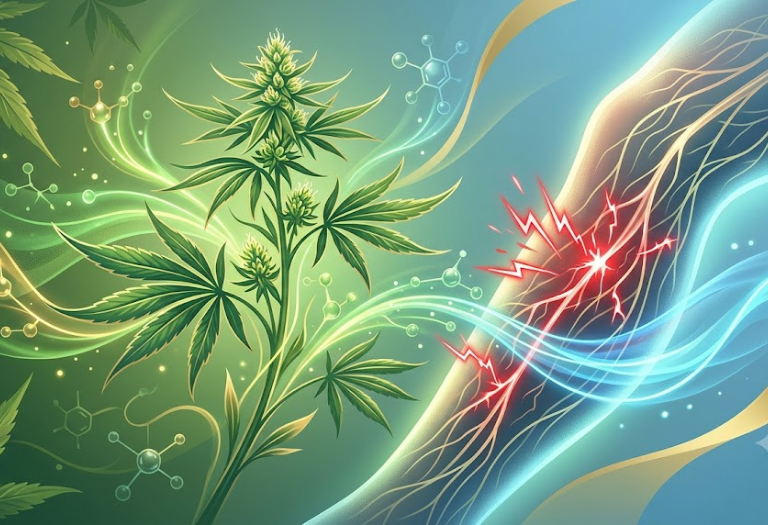
Cannabis contains cannabinoids, primarily THC (tetrahydrocannabinol) and CBD (cannabidiol).
These compounds interact with the body’s endocannabinoid system, which plays a role in pain signaling and nervous-system function.
THC is intoxicating and may influence pain perception. It can also cause dizziness, sedation, impaired concentration, anxiety, or other unwanted effects.
CBD is non-intoxicating and has been studied for pain and other neurological symptoms, although evidence for CBD alone in neuropathic pain is inconsistent.
Importantly, evidence for cannabinoids in general neuropathic pain cannot automatically be applied to trigeminal neuralgia specifically.
Potential Benefits of Medical Cannabis for Trigeminal Neuralgia
Direct research on TN remains limited, but broader research into neuropathic pain provides some context.
Cannabinoid medicines have shown modest pain-relieving effects in some studies of chronic neuropathic pain. A 2025 systematic review found potential benefits across several neuropathic pain conditions, while also emphasizing limitations in study size and duration. (PubMed)
Repeated facial pain can make falling or staying asleep difficult. Some cannabinoid studies report improvements in sleep, although sedation can also occur.
Living with unpredictable pain can create significant stress and anxiety. Some patients may experience a calming effect, particularly with carefully selected formulations.
If symptom burden decreases, patients may find everyday activities easier to manage. However, evidence that cannabis directly improves quality of life in trigeminal neuralgia remains insufficient.
The potential role is symptom management—not elimination of the neurological cause.
What Research Says About Cannabis and Trigeminal Neuralgia
This is where medical accuracy matters most.
There is no strong clinical evidence establishing cannabis as an effective treatment specifically for trigeminal neuralgia.
Research on chronic neuropathic pain suggests cannabinoids can produce small improvements in pain for some patients, but the overall benefits are modest and adverse effects such as dizziness, sedation, nausea, and cognitive effects are more common with some products. (PubMed)
A systematic review of chronic neuropathic pain found cannabinoids were only marginally better than placebo for several pain outcomes and were associated with more central nervous system and psychiatric side effects. (PubMed)
Therefore, TN-specific evidence remains an important research gap.
Why More Research Is Still Needed
Researchers need studies specifically involving people with trigeminal neuralgia to determine:
- Whether cannabis reduces TN attack frequency
- Whether it reduces attack intensity
- Which cannabinoid ratios may be useful
- Appropriate dosing strategies
- Whether cannabis works better for continuous pain than brief attacks
- Long-term safety
- Potential interactions with TN medications
Until those questions are answered, cannabis should be approached cautiously and individually.
Cannabis for Trigeminal Neuralgia: What It May and May Not Do
| Potential role | Current understanding |
|---|---|
| Nerve pain | May provide modest relief in some neuropathic pain conditions |
| Sleep disruption | May help some patients, but sedation is possible |
| Stress | Possible supportive benefit |
| TN attack frequency | Not established |
| Nerve compression | Does not correct it |
| Underlying cause | Does not treat the cause |
| Cure | No evidence that cannabis cures TN |
Pain relief and disease treatment are not the same thing.
Risks and Considerations
Cannabinoids may cause drowsiness or dizziness, which can increase fall and accident risks.
THC can impair attention, memory, coordination, and judgment.
Cannabinoids can affect drug metabolism. This matters particularly when someone is already taking medications such as carbamazepine, oxcarbazepine, or other neurological drugs.
Regular cannabis use can lead to cannabis use disorder in some individuals.
Reducing pain does not necessarily mean the underlying cause has been addressed. Continuing or worsening facial pain still requires appropriate medical evaluation.

Safer Use Principles
If a licensed provider determines medical cannabis is appropriate:
- Start low and increase cautiously.
- Use measured products so dosage can be tracked.
- Discuss THC and CBD options according to individual symptoms.
- Review all medications for potential interactions.
- Track pain, sleep, attacks, and side effects.
- Never stop prescribed TN medication without medical guidance.
The right approach is individualized—not based on another person’s dose or product.

FAQs
No. Cannabis has not been shown to cure trigeminal neuralgia or correct its underlying causes.
It may provide supportive pain relief for some people, but direct evidence in TN is limited.
There is not enough TN-specific evidence to establish one as superior. THC carries greater risks of intoxication and cognitive effects.
There is currently insufficient evidence that cannabis prevents or stops TN attacks.
No. Carbamazepine remains an established treatment for TN and should not be replaced without medical supervision. (Mayo Clinic)
It may help some individuals, but sedation and next-day impairment are possible.
No. Cannabis cannot remove or reposition a blood vessel compressing the nerve.
No cannabis-based treatment is FDA-approved specifically for trigeminal neuralgia.
Possibly, but potential interactions should be reviewed by a qualified healthcare professional.
Yes. A licensed provider can review your medical history, current medications, symptoms, and treatment goals before determining whether medical cannabis may be appropriate.
When to Seek Medical Attention

Seek medical evaluation for new, persistent, or severe facial pain—especially when the pain does not follow a typical TN pattern.
Prompt assessment is particularly important when facial pain occurs with:
- Facial numbness or weakness
- Vision changes
- Hearing problems
- Other neurological symptoms
- Bilateral facial pain
- Symptoms beginning at an unusually young age
These features can indicate another underlying condition requiring investigation. (Right Decisions)
Finding the Right Path Beyond the Pain
Trigeminal neuralgia can make ordinary moments feel unpredictable. Medical cannabis may offer supportive relief for some people dealing with nerve pain, sleep disruption, or the stress that follows repeated attacks—but it is not a cure and should never replace appropriate neurological care.
The goal isn’t simply to find something that takes the edge off.
It’s to find what fits safely into your bigger treatment plan.
At MSNM, licensed medical marijuana providers can review your symptoms, medical history, medications, and goals to help determine whether medical cannabis is an appropriate option under your state’s requirements.
When pain has been dictating your days, the right guidance can help you start taking some of those days back—one step, one choice, and one more comfortable moment at a time.
