
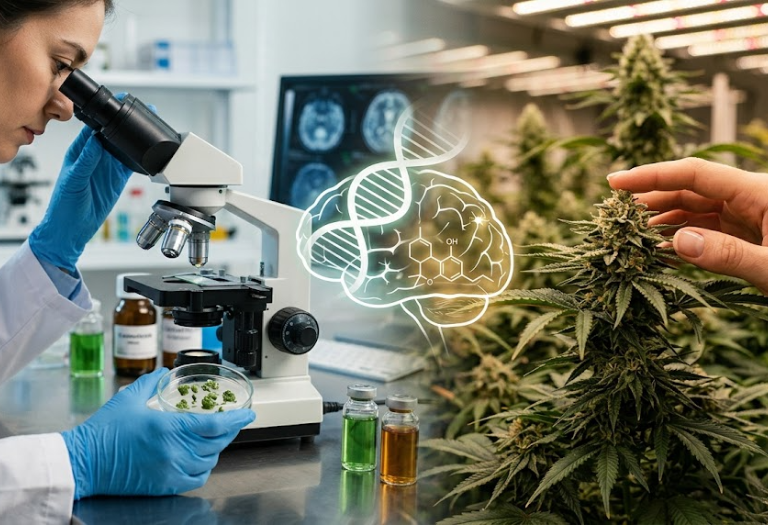
When Movement, Mood, and Memory Begin to Change
Huntington’s disease can affect far more than movement.
Early changes may look like clumsiness, irritability, anxiety, depression, or difficulty concentrating. As the disease progresses, involuntary movements, balance problems, speech difficulties, weight loss, and swallowing problems may become more prominent. (ncbi.nlm.nih.gov)
Because Huntington’s affects movement, cognition, and emotional health at the same time, symptom management often requires several types of support.
This has led some patients and caregivers to ask whether medical cannabis could have a supportive role.
But can cannabis actually help Huntington’s symptoms, and where does it fit within established care?
What Is Huntington’s Disease?
Huntington’s disease (HD) is an inherited neurodegenerative disorder caused by a pathogenic expansion in the HTT gene. It progressively affects areas of the brain involved in movement, thinking, behavior, and emotional regulation.
- Common symptoms include:
- Chorea: involuntary, irregular twisting or jerking movements
- Difficulty with balance and coordination
- Muscle rigidity and slowed movement
- Problems with speech and swallowing
- Depression, anxiety, irritability, or behavioral changes
- Cognitive decline
- Weight loss and nutritional difficulties
Standard Medical Approaches for Huntington’s Disease

There is currently no treatment that cures Huntington’s disease or reverses its underlying neurodegeneration. Care focuses on controlling symptoms and maintaining function and quality of life. (ncbi.nlm.nih.gov)
Medications such as tetrabenazine, deutetrabenazine, and valbenazine may be used to reduce chorea. These medications require careful monitoring because adverse effects can include sedation, depression, restlessness, and other movement-related effects. (ncbi.nlm.nih.gov)
Physical therapy, movement training, and occupational therapy can help patients maintain mobility, safety, and independence for as long as possible.
Speech-language therapy can address communication and swallowing difficulties, particularly as the disease progresses.
Depression, anxiety, irritability, obsessive-compulsive symptoms, and other psychiatric changes may require medications and psychological support.
Weight loss is common in Huntington’s disease. Dietitians and healthcare professionals can help address calorie needs, food texture, and swallowing-related concerns. (ncbi.nlm.nih.gov)
Medical cannabis, if considered, should complement this multidisciplinary approach rather than replace it.
How Cannabis May Affect Huntington’s Symptoms
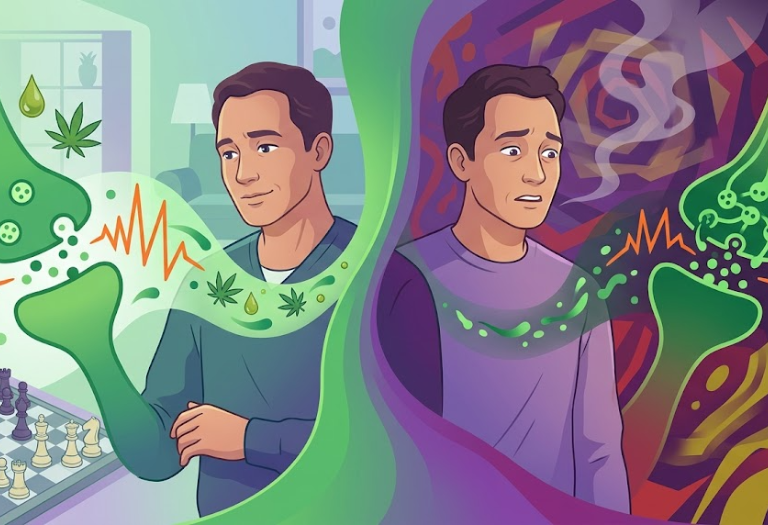
Cannabis contains cannabinoids such as THC and CBD, which interact with the body’s endocannabinoid system.
THC is psychoactive and can influence pain perception, appetite, relaxation, and sleep. It can also cause dizziness, impaired coordination, anxiety, or cognitive effects.
CBD is non-intoxicating and has been investigated for neurological and psychiatric symptoms. However, biological effects and early research findings do not establish CBD as a proven Huntington’s treatment.
Because Huntington’s already affects movement and cognition, these effects require particular caution.
Potential Benefits of Medical Cannabis for Huntington’s Disease
Research specifically involving Huntington’s disease remains limited, but some patients may discuss cannabis as supportive symptom management.
Small studies have investigated cannabinoids for chorea and dystonia. One small study involving seven people with Huntington’s disease reported improvements in motor and dystonia scores after cannabinoid treatment, but its size and design make it insufficient to establish effectiveness. (pubmed.ncbi.nlm.nih.gov)
Cannabinoids have been investigated for pain and muscle-related symptoms in neurological conditions. Some individuals may experience supportive relief.
Sleep disturbances can occur with Huntington’s disease. Cannabis may affect sleep for some people, although sedation and next-day impairment are possible.
Living with a progressive neurological condition can be emotionally challenging. Some people report calming effects from cannabis, while THC may worsen anxiety or paranoia in others.
Weight loss can become a significant concern in Huntington’s disease. THC may stimulate appetite, although appetite changes should be managed as part of a broader nutritional plan.
These potential benefits should be viewed as symptom-specific possibilities—not evidence that cannabis treats Huntington’s disease itself.
What Research Says About Cannabis and Huntington’s Disease
The research is interesting but far from conclusive.
A literature review examining medical marijuana and movement disorders found that studies in Huntington’s disease were limited and varied in quality. Research has examined symptoms including chorea, dystonia, sleep, and other movement-related problems. (pubmed.ncbi.nlm.nih.gov)
A small study of synthetic cannabinoid nabilone also reported a reduction in chorea scores, but the study involved only 22 participants and was not large enough to establish cannabis as a standard treatment. (pmc.ncbi.nlm.nih.gov)
Some early research has therefore produced encouraging signals, but larger, well-controlled clinical trials are still needed.
Why More Research Is Still Needed
- Which cannabinoids are most useful?
- Can cannabis meaningfully reduce chorea?
- Could it help dystonia or muscle discomfort?
- What doses provide benefit without worsening cognition?
- How does cannabis interact with Huntington’s medications?
- What are the long-term effects?
- Which patients are most likely to benefit?
Risks and Considerations
Safer Use Strategies
If a licensed provider determines that medical cannabis may be appropriate:
- Start low and adjust gradually.
- Use measured formulations to track dosage accurately.
- Review all medications before starting cannabis.
- Monitor movement, cognition, mood, and alertness.
- Be especially cautious with THC if psychiatric or balance problems are present.
- Involve caregivers when cognitive or physical impairment affects medication management.
The objective should be measurable symptom support—not simply increasing cannabis exposure.


FAQs
No. Cannabis cannot correct the genetic cause of Huntington’s disease or reverse its progression.
There is currently no established evidence that cannabis slows the underlying neurodegeneration.
Small studies have reported possible improvements, but the evidence is insufficient to establish cannabis as a standard chorea treatment.
Some early research suggests potential benefit, but larger studies are needed.
There is not enough evidence to say that one cannabinoid is universally better. THC also carries greater risks of intoxication and cognitive effects.
Some people may experience relaxation, but THC can worsen anxiety or psychiatric symptoms in others.
THC may stimulate appetite, which could potentially be useful for some patients experiencing weight loss.
No. Established medications and multidisciplinary care remain important for managing Huntington’s symptoms.
No cannabis-based treatment is FDA-approved specifically to treat Huntington’s disease.
Yes. A qualified provider can consider symptoms, medications, psychiatric history, cognitive function, and individual risks before recommending whether cannabis is appropriate.
Finding the Right Path to Supportive Care

Huntington’s disease can change movement, thinking, mood, and independence—but supportive care can still make a meaningful difference in how someone navigates those changes.
Medical cannabis may help some individuals manage specific symptoms such as pain, sleep disruption, appetite changes, or certain movement-related discomfort, but it is not a cure and should never replace neurological treatment.
The goal isn’t to replace the care already working.
It’s to find whether another carefully chosen piece can make that care work better for you.
At MSNM, licensed medical marijuana providers can review your symptoms, medical history, medications, and individual needs to determine whether medical cannabis may be an appropriate supportive option under your state’s requirements.
The right path isn’t always about finding one answer—it can be about finding the right combination of care that gives everyday life a little more comfort, control, and possibility.